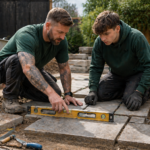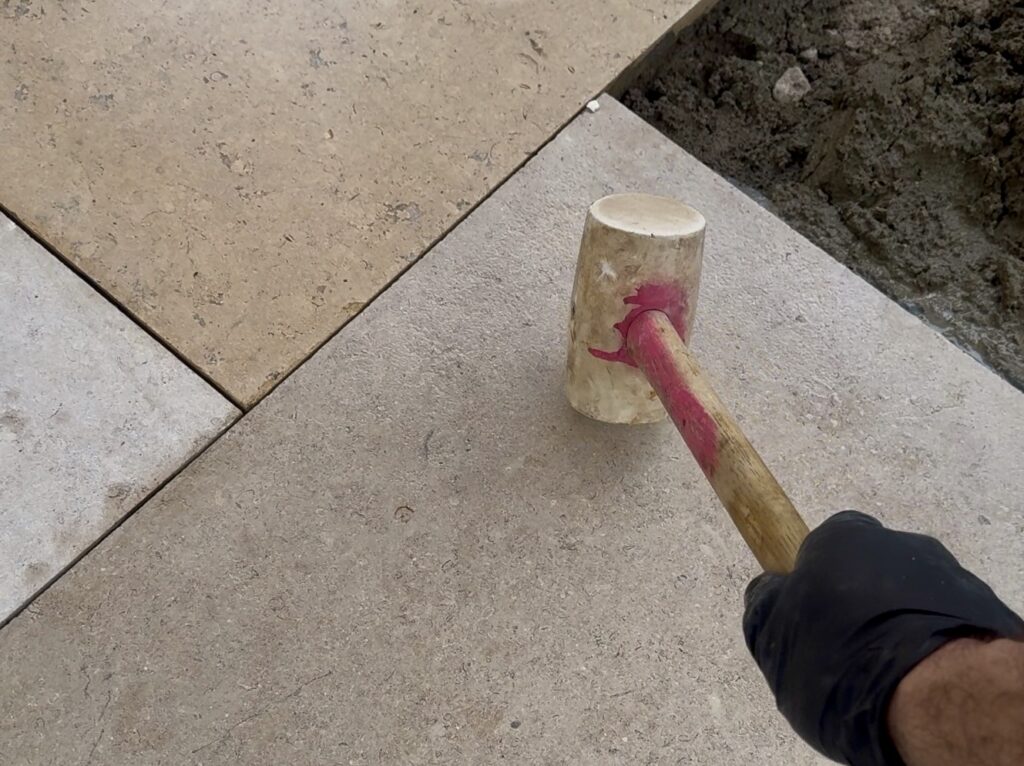
Watch a quick demonstration of this technique below.
Laying paving slabs might look simple, but beginners often run into one common problem: the slabs don’t sit properly on the bed and end up rocking or moving.
In many cases, the issue isn’t the base or the mortar — it’s how the slab is being knocked down into place.
The Mistake Most Beginners Make
A mistake we often see is people hitting the corners of the slab when trying to bed it down.
When you strike the corners repeatedly, the slab starts to behave like a pivot or swing. Instead of settling evenly into the mortar bed, the pressure transfers across the slab and can lift the opposite corner.
This can make the slab difficult to level and may leave voids underneath.
The Simple Trick That Works
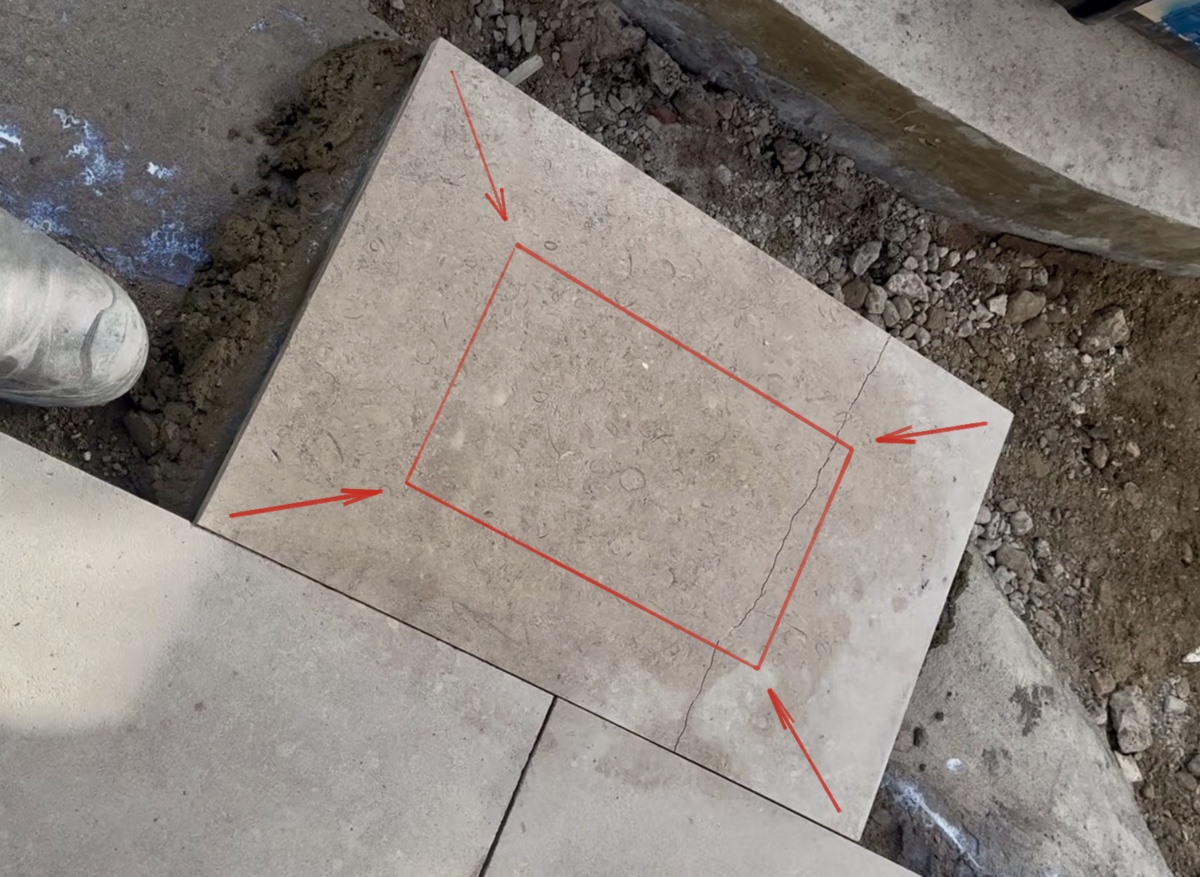
In the image above, you can also see a cracked paving slab. This wasn’t caused by overworking — but that’s a topic for another day.
A useful trick is to imagine that the slab is slightly smaller than it actually is.
Instead of hitting near the outer corners, aim your mallet strikes slightly in from the edges. This helps distribute the pressure more evenly across the slab and allows it to settle properly into the bedding layer.
Using this approach makes it much easier to:
- Seat the slab evenly
- Reduce rocking or movement
- Achieve a consistent level
- Avoid disturbing the bedding mortar
Somebody commented on the video above suggesting that you should imagine a circle instead of a rectangle.
Feel free to try working with an imaginary circle if that helps you bed the slab more evenly — it’s the same principle.
Another Way To Look At This
Assuming the mortar bed has been prepared correctly, when you strike the slab you are effectively shaping the mortar underneath.
By hitting the edges and corners, you push the outer edges of the mortar bed too low. At the same time, you compact the centre, which can leave it too high.
The goal is to compact the mortar evenly across the entire slab.
When you aim towards the interior of the slab, the mortar is pushed outwards evenly.
When you hit the edges and corners, the mortar is forced inwards, which can cause difficulties leveling the stone.
Use a correct Rubber Mallet
There are different sizes and hardness levels of rubber mallets designed for different types of work.
Choose a mallet that suits the job.
Use white rubber mallet for light coloured stone. Less likely you’ll leave difficult to remove stains.
Work gradually and check the level frequently to make small adjustments as the slab beds down.
Final Thoughts
Small technique adjustments can make a big difference when laying paving slabs. Avoiding the corners and focusing your strikes slightly in from the edges helps slabs settle properly and saves time when levelling.
If you’re just starting out with patio installation or landscaping work, learning these small details early can make the whole process much smoother.