Even though there are no truly straight lines in nature, they are everywhere in the human world.
Gardens are no exception. Many modern garden designs rely on clean, straight lines — sharp edges, defined borders, precise paving patterns, and structures that bring order to natural surroundings.
Straight lines stand out against the “chaos” of nature. That’s why it’s usually easy to tell whether something is straight… or not.
Here, I’m talking about small-scale projects — typical London gardens — where straight runs rarely exceed an 8m tape measure. Fencing lines might be an exception, but most paving, edging, and detailing happens within a compact space.
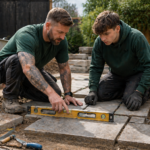
As a landscaper or builder, you create straight lines one cut at a time — one brick, one paving slab, one adjustment at a time.
And that’s exactly what this post is about: how to achieve straight lines in landscaping using skill, not just tools.
Straight Lines on a Building Site
Whether you’re trying to cut a paving slab straight or achieve a clean edge in block paving, there are only two possibilities: it is straight or it is not.
You’ve probably seen — and I’ve heard plenty about — “magic tools” that promise perfectly straight cuts. Guide rails, attachments, specialist saws… and yes, they all have their place.
But here’s the reality.
As a small landscaping business or sole trader, you can’t own or hire every specialised tool for every situation.
And more importantly — you shouldn’t have to.
With the right technique, you should be able to cut paving slabs straight using basic tools like an angle grinder or disc cutter. The result depends far more on your control and process than the tool itself.
Achieving “Straight” in One Go
A common misconception — especially among beginners — is that perfect straight cuts in paving can be achieved in one pass.
You look at a clean, sharp edge and think:
“There must be a special tool for that.”
Or:
“There must be a trick.”
In reality, it’s neither.
It’s skill — built over time through repetition, mistakes, and corrections. Learning how to adjust and refine your cuts is what separates average work from professional results.
The “Special Way”
There is no shortcut — just a repeatable process for achieving straight lines in landscaping:
- You understand the process
- You learn the material
- You learn the tools
- You have a backup plan
- You make your best attempt
- You assess the result
- You make adjustments
That’s the “secret” behind consistently straight cuts and clean lines.
Evaluating the Result
The result is what matters.
Not the tool. Not how fast you did it. Not how impressive it looked while you were cutting.
If you aim to create a straight line in paving or brickwork:
- It is not a snake.
- It is not a zigzag.
- It is not a stepped edge.
It is the shortest distance between two points.
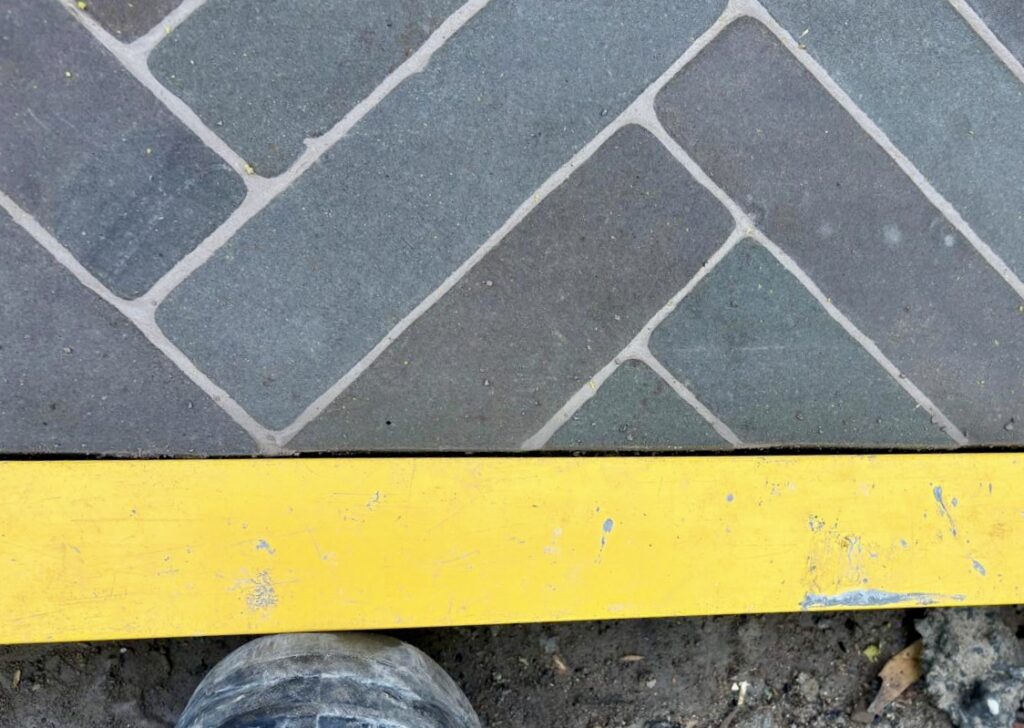
And you should check it properly:
- Use a spirit level or straight edge
- Run a string line along the cut
- Step back and assess visually
This is how you ensure accuracy in landscaping and maintain a professional standard on site.
3D Lines
A straight line is a one-dimensional form.
Above, I was talking about 2D lines. You might draw a straight line on a paving slab — but end up with a wavy cut.
When thinking about a line in 3D, consider something like corner beading on a rendered raised bed.
When installed correctly, the bead creates a clean, linear edge — one that should be parallel to the internal bead and consistent along its length.
But again, it’s not about installing it quickly.
It’s about checking it properly:
- Run a string line along the face
- Check across the top
- Look for consistency from multiple angles
Only then can you say it’s straight.
Final Thoughts
Straight lines don’t come from tools — they come from standards.
Anyone can buy equipment, but not everyone takes the time to check, adjust, and refine their work.
The difference between average and high-quality landscaping comes down to small decisions:
- Taking an extra minute to check a line
- Making a second pass to correct a cut
- Refusing to accept “good enough”
In the end, achieving straight lines in landscaping is about consistency and attention to detail.
And that’s what separates a job that looks finished… from one that looks right.
Tools to Help You Get Straight Lines Right
Disclosure: This section of this post may contain affiliate links, meaning Flexi Landscapes get a commission if you decide to make a purchase through links below, at no cost to you.
While straight lines in landscaping come down to skill and process, having the right basic tools makes checking and adjusting much easier.
Spirit Level
A solid spirit level is one of the simplest ways to check straightness on-site.
A longer level (1000–1200mm) gives you a better reference over distance and makes it easier to see where adjustments are needed.
Feather Edge
A straight edge is often overlooked, but it’s one of the most reliable ways to check flat, clean lines — especially on paving.
Unlike a spirit level, it doesn’t rely on bubbles — just a clean, true edge you can trust.
The longer the better. The downside of very long featheredge – troubles storing and transporting it.
String Line
For longer runs, nothing beats a properly set string line.
It’s simple, cheap, and extremely effective — as long as it’s set up correctly and kept tight.
You won’t get away without one.