Planting larger trees can be physically demanding and easy to get wrong. A poorly prepared planting hole or incorrect positioning can cause unnecessary stress for both the tree and the person planting it.
This guide covers practical tips for planting larger trees correctly, helping you avoid common mistakes and make the process smoother.
What Do We Mean by “Larger Trees”?
By “larger trees,” I mean smaller trees that are difficult for one person to lift and manoeuvre safely.
In most planting projects, the largest trees and shrubs from the planting plan are positioned first, with smaller plants arranged around them afterwards.
Example: Planting a Multi-Stem Magnolia
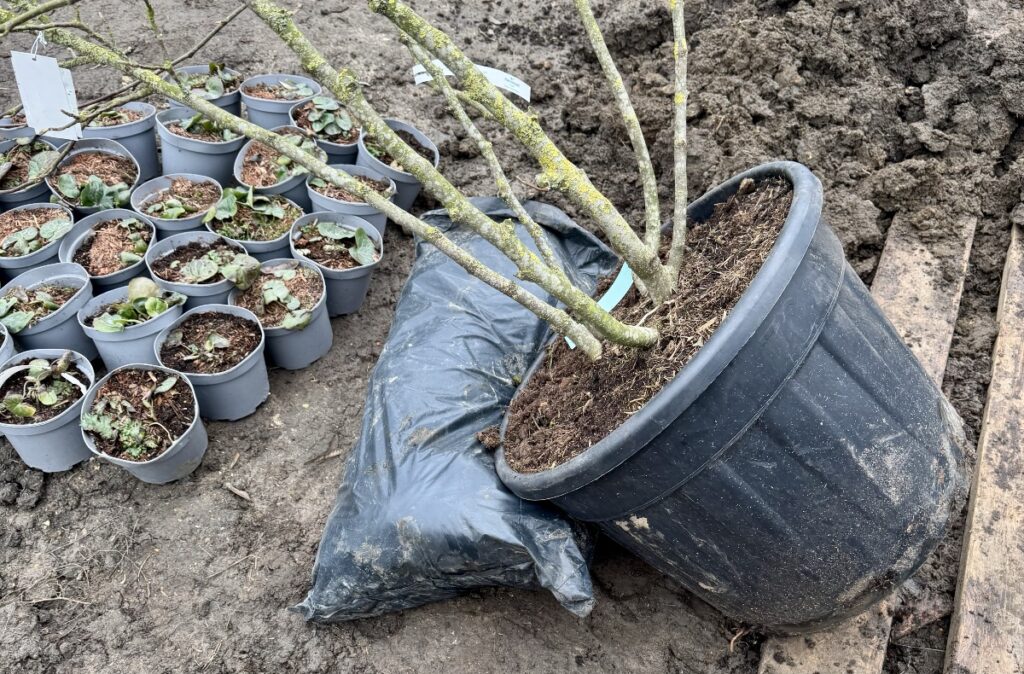
This multi-stem magnolia (shown in the video) is in a 70-litre pot — a size where extra hands are often needed.
It can be difficult to judge the weight, as it varies depending on how much water is in the root ball.
Although one person may be able to move it, the stems are too slender for the size and weight of the pot. The multi-stem structure also makes it harder to handle safely — both for the plant and the person.
Every branch contributes to the overall size and shape of the tree, so protecting the plant is far more important than trying to manage it alone.
Watch a short version of planting Magnolia:
Digging a Planting Hole for Larger Trees
Dig a hole larger than the root ball.
It sounds obvious, but this is one of the most common tree planting mistakes.
Digging is a tiring job, even in good soil, so it’s easy to stop too early. Later, people try to force a heavy and awkward tree into a hole that is too small.
This usually leads to problems:
- The tree sits too high or too low
- The positioning is wrong
- The tree has to be lifted out again
- The root ball gets disturbed
Taking a few extra minutes to dig a proper planting hole at the start avoids all of this.
Why You Should Dig a Larger Planting Hole
1. The Tree Must Fit Properly
Nursery pots are uniform and easy to measure.
However, field-grown or burlapped trees often have irregular root balls. Digging a larger planting hole makes it much easier to position them correctly without forcing them into place.
2. Allows for Proper Positioning
When planting larger trees, positioning matters — especially in smaller gardens.
Multi-stem trees are rarely symmetrical. You may need to rotate the tree — sometimes even 180 degrees — to achieve the best visual result or hide structural imperfections.
Even single-stem trees usually have a “better side.”
In addition, trees are not always centred in their pots or root balls. A larger planting hole gives you the flexibility to adjust and position the tree correctly.
3. Adjust Height Without Heavy Lifting
One of the biggest advantages of a larger planting hole is that it allows you to adjust the height without lifting the tree repeatedly.
If the hole is too tight and the tree sits too high, the only solution is to remove it and dig more.
Instead, dig the hole wide and deep enough from the start.
If too deep:
- Tilt the tree slightly
- Add soil under the root ball
- Repeat until the correct level is achieved
This method saves effort and reduces the risk of damaging the tree.
Common Mistakes When Planting Larger Trees
Avoid these common tree planting mistakes:
- Digging the hole too small
- Planting the tree too high
- Poor positioning
- Damaging the bark during handling
- Trying to move heavy trees alone
Teamwork Matters
When planting larger trees, teamwork is essential.
If more than one person is involved:
- Agree on the plan before starting
- Communicate clearly during the process
- In more complex situations, one person should lead and give instructions
This reduces confusion and prevents accidents or damage.
Protect the Tree at All Costs
The most important rule when planting larger trees is simple:
Protect the bark of the trunk and stems at all costs.
Damage to the bark can weaken the tree and affect its long-term health.
Always prioritise the condition of the plant over speed or convenience.
Final Thoughts
Planting larger trees doesn’t have to be difficult, but it does require planning, patience, and the right approach.
By digging a proper planting hole, allowing room for adjustments, and handling the tree carefully, you can ensure a successful planting process and a healthier tree in the long run.